Sandblasting
Something went wrong. Please try again later...
By Dairyland Seed Agronomy Team
By Dairyland Seed Agronomy Team
With our recent strong winds across the Dairyland Seed footprint the last few days or, in some instances, weeks, we may be experiencing sandblasting. Sandblasting is when soil particles are picked up and carried or blown about by the wind. When these soil particles come in contact with leaf surfaces, they cut into the leaf tissue causing tattering of leaves or, in some instances, shearing off of stems.
Corn plants that experience sandblasting will have tattering of leaves and may be shorn off but, in some cases, they will get dirt in the whorl and the leaf will roll up tight as shown in the photo below.
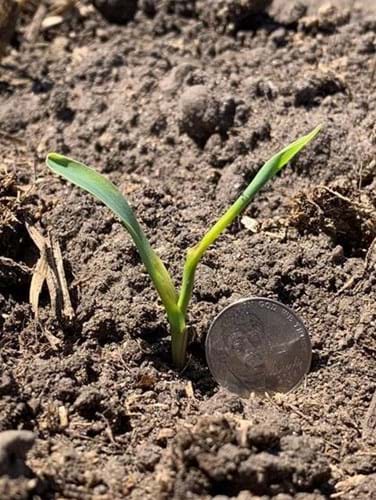
After the rolling of the leaf, it may unfurl to reveal a yellow leaf or a yellow flash on the leaf. This happens because the rolled-up part didn’t receive enough sunlight. If the leaf is wrapped very tight, and growing conditions (moisture and sunshine) are not good, the rolled-up leaves will burst through and more than just one leaf will be yellow. All hybrids, from all companies, can show yellow flash in this instance. Plants and/or hybrids with upright leaves or more upright leaves can trap more soil in the whorl making more yellow leaves.
In most instances, sandblasting or soil/dirt in the whorl does not kill a corn plant. However, if other factors such as a compromised root system that is diseased or injured, or if the corn plant had to struggle to emerge and does not have energy reserve left in the seed, this wrapping of the leaf does not allow the plant to photosynthesis and plants can be lost. This is more critical prior to V3-V4 corn, when the plant is putting out a great amount of energy out for roots and leaves. Cool and cloudy days do not help in these instances.
Sandblasting and having dirt/soil in the whorl of the corn plant increases the potential for diseases such as Goss’s Wilt to infect the plant.
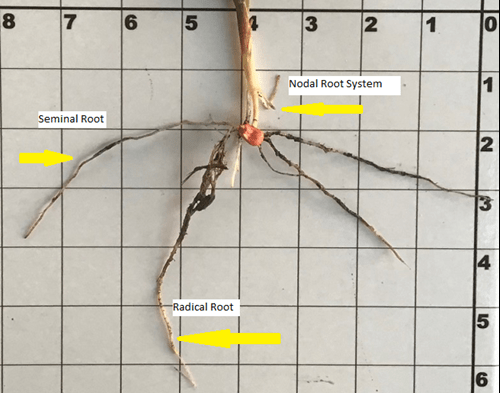
Wind and very high soil temperatures can also produce a variation of “Rootless Corn”. Rootless corn occurs when hot dry soil gets too warm (90°F or more) and/or has an open seed furrow, limiting the plant’s ability to put out its seminal root system. The seminal roots start to emerge at 60-70 Growing Degree Units (GDUs) and anchors the corn plant until V3 when the nodal root system takes over. If the seminal roots do not develop adequately to anchor the plant, as the corn plant puts out its first few leaves, the surface area of those leaves with the high winds, causes the plant to “sit and spin”. If the plant spins enough, it will girdle the plant, causing an area for disease to enter the seedling, or the above ground portion of the plant to spin off. In most instances, if the plant “spins” off, the plant will die from seedling disease.
In the case of soybeans, if the plant has emerged and the cotyledons are out, or even just the hypocotyl is exposed, soil particles can “blast” away at the tissue and cut the plant in two, killing the plant. (As shown in the photo below.)
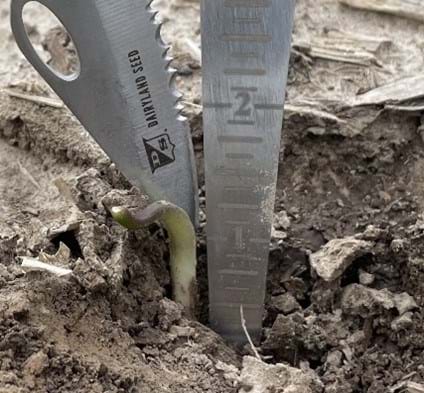
If soybean plants are in the first trifoliate growth stage or later and the tissue is cut or effected above the first trifoliate, the plant will react the same as it being hailed on and will grow from the auxiliary buds.
Much like other stresses on plants, if you have more than one malady affecting the plant, sandblasting can or could be the one stress too many, and the plant succumbs to all of them.
If you have questions about this or other Agronomy topics, please contact you Dairyland Seed Regional Agronomist.
 Brian Weller |
 Dan Ritter |
 Chad Staudinger |
 Mark Gibson |
 Amanda Goffnett |
 Ryan Mueller |